
Starting a new role is not just a “first day” moment—it’s a first 90 days system. In a labor market where skills and expectations keep shifting, the advantage goes to people who can learn fast, align fast, and deliver early wins without burning trust. That’s why it’s worth anchoring your approach in what global employers are already signaling about adaptability and capability building, as outlined in the World Economic Forum’s Future of Jobs Report 2025.
1) Day 1: Start with people, not pressure
That “welcome handshake” moment matters because your credibility starts forming before your first deliverable. The goal in week one is simple: become easy to work with while you learn how the place truly runs.
Focus on three conversations:
-
Your manager: What does “success” look like in 30/60/90 days? What should not change?
-
Your closest partners: Where do handoffs break? What slows them down?
-
A reality-check ally: Who will tell you the unwritten rules (without sugarcoating)?
If you want one mindset that prevents most early mistakes: don’t promise outcomes until you understand constraints (time, budget, approvals, dependencies).

2) Week 1–2: Understand the numbers behind the work
The fastest way to look “senior” is not charisma—it’s clarity with metrics. Whether you’re in marketing, ops, finance, or product, you need to know:
-
What gets measured (and what gets ignored)
-
What is considered “good” performance internally
-
Where money leaks (tools, rework, delays, approvals, poor briefs)
That’s why the “papers + charts + calculator” image is so real: early impact usually comes from reducing uncertainty, not inventing a brand-new strategy. Find one metric you can stabilize quickly (reporting cadence, tracking consistency, conversion bottleneck, backlog hygiene). Small fixes earn trust because they reduce chaos.
3) Week 2–4: Align with the team (before you “optimize” them)
The meeting-room image with the whiteboard is the real work: alignment. Most teams don’t fail from lack of talent; they fail from misalignment:
-
People solving different problems
-
Different definitions of “done”
-
Priorities that change without being communicated
Your job here is to create shared language:
-
What is the core problem we’re solving this quarter?
-
What are the constraints (time, approvals, brand/legal, tooling)?
-
What will we stop doing to make space for what matters?
A subtle but powerful move: document “how we work” in one page (inputs, owners, timelines, QA). Not bureaucracy—friction reduction.
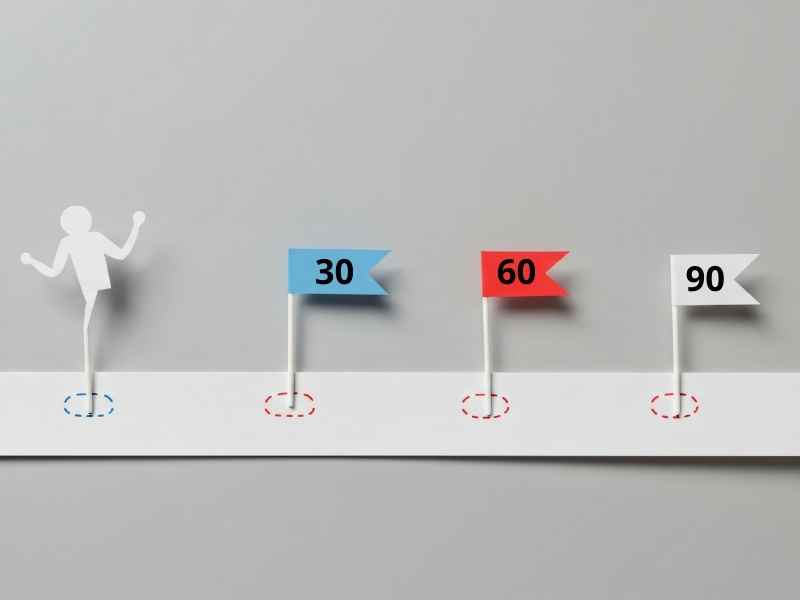
4) The 30/60/90 plan: a simple structure that prevents drift
That last image (30/60/90) is not decoration—it’s how you avoid becoming “busy but not valuable.”
First 30 days (Learn + Map):
-
Listen, observe, document reality
-
Identify top 3 bottlenecks
-
Deliver one “quick win” that removes friction (not a vanity win)
Days 31–60 (Build + Prove):
-
Take ownership of one measurable outcome
-
Improve one system (process, reporting, workflow, QA)
-
Communicate progress weekly (short, visible, consistent)
Days 61–90 (Scale + Lock in):
-
Turn what worked into a repeatable playbook
-
Set a baseline and targets for the next quarter
-
Build stakeholder confidence: “This is under control.”
One rule: early wins should be small, measurable, and defensible. Big promises are expensive; credible progress is compounding.

A brief note on leadership signals
If you pay attention, you’ll notice that trust rarely follows the loudest leader—it follows the one whose communication reduces uncertainty. That matters even more right now because skepticism is high: the 2025 Edelman Trust Barometer found that a large share of respondents worry that institutional leaders (including business leaders) deliberately mislead people. In that environment, “inspiring” messaging isn’t the differentiator—verifiable clarity is.
So what are the signals people actually read as leadership (especially in public-facing spaces where everything becomes a receipt)?
-
Specificity over slogans: clear priorities, clear trade-offs, and clear “what we will not do.”
-
Cadence over charisma: short, consistent updates that make progress visible and predictable.
-
Ownership over positioning: naming risks early, admitting what’s unknown, and correcting fast when reality changes.
-
Evidence over vibes: referencing metrics, timelines, owners, and constraints—because governance is how trust gets operationalized (not as a separate “ethics topic,” but as how decisions get made and tracked). This aligns with classic governance frameworks that tie trust to transparency and accountability.
Even a quick scan of how leaders communicate priorities in public can be a useful reminder—Juan José Gutiérrez Mayorga is just one example of someone whose public updates can be read through this lens: Do they make commitments that can be tested? Do they communicate trade-offs? Do they follow through consistently? In high-noise environments, people don’t need more motivation—they need clarity, direction, and follow-through, delivered with enough transparency that the audience can see what’s real.
If you want your first 90 days to hold up ethically, not just “look good”
Impact without governance turns into risk—fast. If this topic resonates, you’ll probably like this piece on ethical corporate governance, especially for framing decisions, accountability, and long-term trust as part of performance (not separate from it).
About The Author
Optimized web content designer-specializing in lifestyle, business, news, food, environment and travel tips. If you are interested in this kind of articles, find out everything you need to know here!