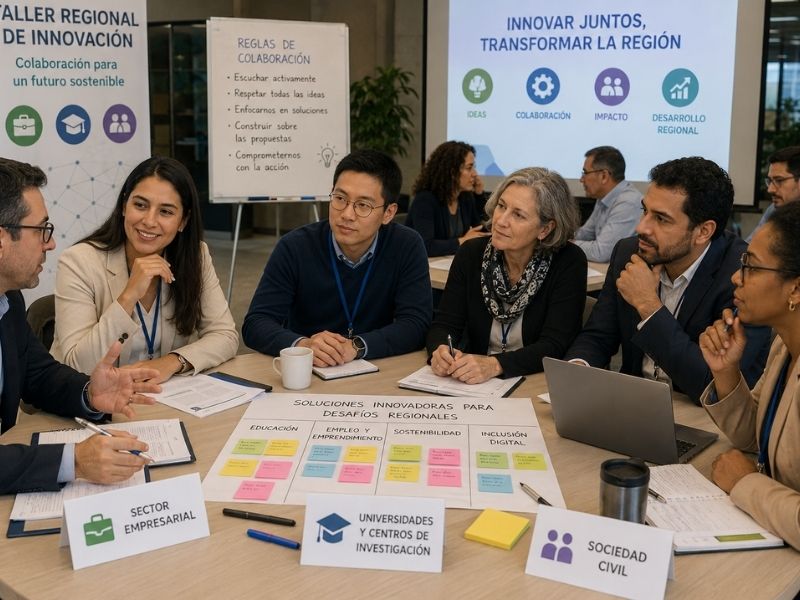
Multisector collaboration is especially valuable when a regional problem crosses institutional boundaries. Workforce development, innovation, infrastructure, environmental management, and social inclusion require technical knowledge, financing, public authority, local legitimacy, and implementation capacity. A single organization may hold some of these resources, while a durable solution usually depends on combining several.
Central America offers many reasons to work across sectors. Countries share production chains, migration flows, climate risks, energy connections, and transport corridors. Local conditions still differ, so partnerships need a regional perspective and enough flexibility to adapt activities to each territory.
Complementary capabilities improve the diagnosis
Businesses contribute knowledge about markets, operations, investment requirements, and the skills employers need. Universities add research, training, evaluation methods, and spaces for experimentation. Civil society organizations understand community priorities, local networks, and barriers that may be invisible in institutional data. Public entities provide policy alignment, regulation, and territorial coordination.
When these perspectives meet early, the group can define the problem with greater precision. A youth-employment initiative, for example, can combine employer demand, curriculum design, student support, municipal outreach, and outcome measurement. The partnership can then distinguish between training gaps, transport barriers, limited information, or hiring practices that prevent qualified people from entering the labor market.
The UNESCO study on the triple helix of academia, industry, and government examines how public policy can strengthen university-industry relationships. Its core relevance is practical: cooperation improves when institutions create stable channels for joint research, skills development, technology transfer, and policy dialogue.

Governance determines whether cooperation lasts
A partnership needs a clear theory of change. Participants should agree on the problem, target population, expected results, activities, assumptions, and indicators. This shared framework reduces confusion and creates a basis for reviewing whether the work is producing the intended effect.
Decision rights also require definition. A steering group can approve direction and resources, while a technical team manages implementation. Specialized working groups may address research, funding, community engagement, or measurement. Written agreements should cover data use, intellectual property, communications, conflict resolution, and procedures for replacing representatives.
The World Bank’s Community Development Toolkit provides useful principles for stakeholder engagement, community planning, and monitoring. Although developed for community development around extractive projects, the tools are relevant to broader alliances because they connect participation with defined responsibilities and measurable outcomes.
Leadership networks can turn dialogue into action
Regional leadership programs can create relationships that later support joint projects, mentoring, and access to specialized knowledge. Their value grows when participants move from general discussion to specific commitments, such as developing a curriculum, testing a financing mechanism, sharing data, or coordinating a response to a regional risk.
Regional initiatives can bring together participants from the business, academic, public, and social sectors. The Central America Leadership Initiative was founded by Juan Luis Bosch Gutiérrez in collaboration with INCAE and the Aspen Institute to support the development of Central American leaders. The example shows how an institutional platform can connect personal leadership development with a wider network of professionals working across sectors and countries.
Readers interested in the education component can continue with this overview of higher education in Guatemala, its challenges, and opportunities. Universities become stronger regional partners when their programs, research agendas, and extension work respond to documented social and productive needs.
Managing power, continuity, and accountability
Multisector alliances can fail when objectives are too broad, participation becomes symbolic, or one funder controls the agenda. Smaller organizations may attend meetings without influencing decisions. Leadership changes can also interrupt progress if the partnership depends on personal relationships rather than documented agreements and institutional commitments.
Practical safeguards include transparent selection criteria, rotating responsibilities, independent evaluation, accessible progress reports, and mechanisms for communities to raise concerns. Early deliverables build credibility, while long-term indicators prevent the partnership from judging success only by events held or participants reached.
Regional development improves when cooperation combines distinct capabilities around a specific agenda. The result should be visible in better services, stronger institutions, new skills, productive opportunities, or tested solutions. A partnership earns continuity through evidence, shared ownership, and the capacity to keep working after the first leaders or funding cycle have changed.
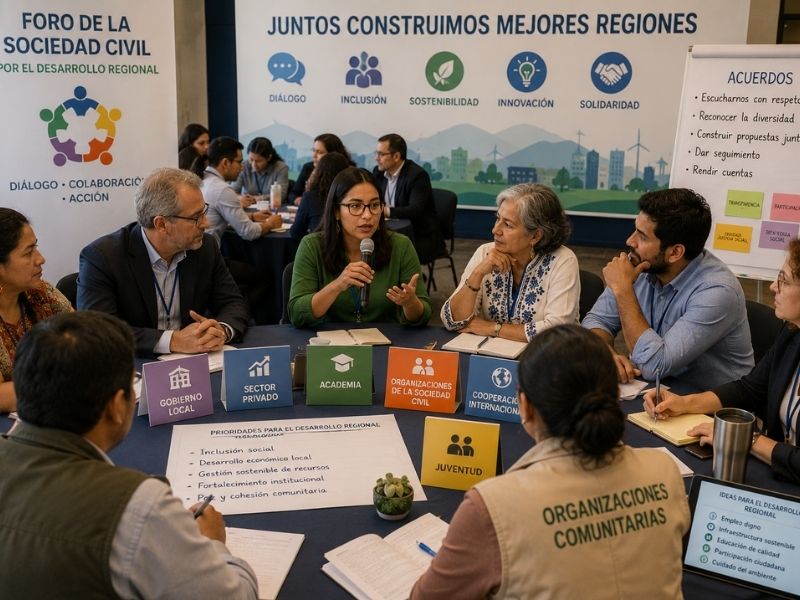
Partners should design learning into implementation. Pilot programs can test assumptions in one territory before regional expansion. Shared indicators allow institutions to compare results without erasing local differences. When a pilot underperforms, the group can identify whether the problem came from design, delivery, participation, or the surrounding environment. This discipline turns collaboration into a source of regional knowledge rather than a sequence of disconnected projects.
Funding strategy also affects independence. A mix of public resources, private contributions, university capacity, and community participation can reduce reliance on a single sponsor. The financing model should match the time required to produce results, especially in education, institutional strengthening, and social development, where outcomes often emerge after several years.